
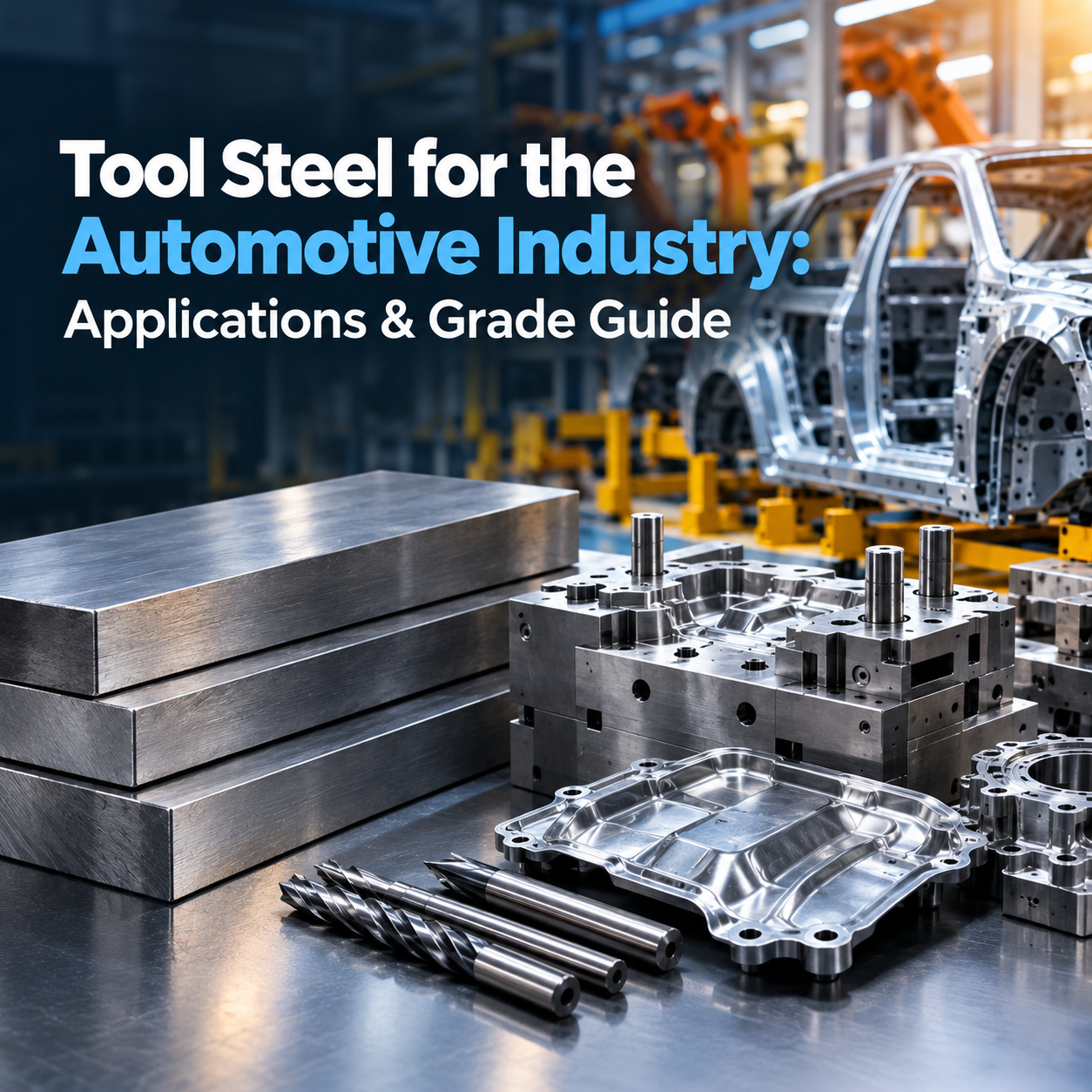
The automotive industry depends on precision, durability, and consistent performance at every stage of manufacturing. From stamping body panels to producing engine components and moulding plastic parts, tooling plays a critical role in maintaining production quality. Choosing the right tool steel gradeshelps manufacturers achieve longer tool life, better dimensional accuracy, and reduced downtime.
Different automotive applications require different tool grades, depending on factors such as wear resistance, toughness, hardness, heat resistance, and machining requirements.
Where Tool Steel Shows Up in Automotive Production
Tool steel is used across several automotive manufacturing processes. In stamping and forming operations, dies must withstand repeated impact and high mechanical loads. D2 tool steel manufacturer solutions are commonly considered for applications requiring high wear resistance and dimensional stability.
Mould manufacturing is another important application. Plastic components such as dashboards, trims, covers, and interior fittings require moulds capable of maintaining precision through repeated cycles. P20 steel supplier products are widely used for plastic mould applications because of their machinability, toughness, and suitability for mould manufacturing.
Automotive manufacturers also use high-speed steels for cutting tools, drills, milling cutters, and other machining applications. Grades such as M2 steel supplier and M35 steel supplier materials are selected where cutting performance and resistance to wear are important.
Grades Commonly Used in Automotive Tooling
Selecting appropriate tool steel grades depends on the tooling application and operating conditions.
D2 tool steel supplier materials are suitable for cold-work tooling where excellent wear resistance and dimensional stability are required. They can be used for dies, punches, forming tools, and other components exposed to repeated wear.
H13 steel supplier materials are commonly considered for hot-work applications because of their combination of toughness, thermal fatigue resistance, and performance at elevated temperatures.
High-speed grades such as 1.3243 steel and 1.3343 steel supplier materials are used for cutting and machining tools where hardness and wear resistance are essential. Powder metallurgy materials can provide enhanced properties for demanding tooling requirements. A powder metallurgy steel supplier can offer grades designed for applications requiring high wear resistance and performance consistency.
Other grades, including ASP23 steel, ASP30 steel, 1.2311 steel, and 1.2344 steel supplier materials, may be selected according to the specific tooling, moulding, machining, and production requirements.
What Automotive Buyers Should Prioritize
When sourcing tool steel, automotive buyers should evaluate more than just grade and price. The steel should offer the required combination of hardness, toughness, wear resistance, machinability, and dimensional stability.
Reliable availability is equally important for production schedules. Working with an experienced 1.2379 steel supplier in India can help manufacturers access consistent material and suitable processing support. Buyers should also consider stock availability, material certification, processing capabilities, delivery timelines, and technical support.
Conclusion
The right tool steel can directly influence tooling life, production efficiency, and component quality. Understanding different tool grades and their properties allows automotive manufacturers to select materials according to actual operating conditions.
With a broad range of tool and die steels, mould steels, high-speed steels, and powder metallurgy solutions, Sandeep Edgetech supports industries requiring reliable and performance-focused steel solutions for precision tooling and manufacturing applications.